Showing posts with label Library of Congress. Show all posts

Wednesday, November 4, 2020

Mrs. White and her sons at tea, circa 1902


I'd been looking for old public-domain tea images on the Library of Congress website when I came across one I'd not seen before, and oh, this one inspires so many questions! It looks rather "styled," doesn't it? The caption info says the photo is of Jane White with sons Lewis and Maynard White "seated at dining table with teacups." Those two little boys do not at all look like willing tea party participants, and since Mrs. White is looking down, it's hard to know what emotions she brought to the table. The little boy at left looks like he'd rather have a root canal (or its equivalent, back in the day), and the little boy at right looks curious, like he's wondering what the photographer is up to.
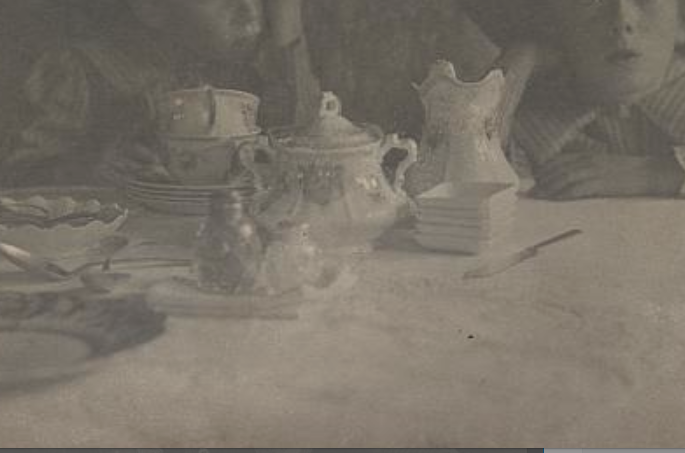
The original photo on the Library of Congress website is not the sharpest, but when I enlarged it on my computer, the sugar bowl and creamer look like some of those pretty old German pieces I've seen, and I'm picturing it with pale-pink roses. Again, the delicacy is so at odds with the two country-looking little boys, isn't it?

According to the LOC, the photo is part of "The White Family Collection in Memory of Clarence H. White, Jane Felix White, and Maynard Pressley White, Jr." When I looked up the names, I found that the boys' father, Clarence White, a native of Ohio, "was an inventive artist, an influential leader of the American Pictorialist movement, a pioneer in the development of photographic magazine illustration and advertising, and founder of the first school of fine art photography in the United States." So can we assume that Clarence took this photo himself? If so, I'm guessing that the little boy at left had probably already had his photo taken by Dad about a hundred times that day and wanted to go out and play. Your thoughts?

The original is here if you'd like to enlarge this photo and check it out yourself!


Friday, October 2, 2020

Tea plantations, the old and the new


I'm so glad a blog reader taught me how to look at those old stereographic images on the Library of Congress website so that I began to see them in 3D. This week, I came across this old image of a tea plantation in Japan, and I'm amazed at how the hills seem to come alive. Are you able to stare at these until you see them in 3D? If not, here's an article that explains the technique. Once you learn how to "see" them, it's like having a built-in View-Master available at all times. 


Here's an enlarged image of one panel.


Tea plantations were on my mind for quite another reason this week when I came across a new china pattern, Gardens of Lyra by Paul Scott, on the Fortnum & Mason website. "Designed exclusively for Fortnum & Mason, Gardens of Lyra takes inspiration from tea plantations around the world and their surrounding landscapes." (Click here to see a detailed view of the plate.) The only tea plantation I've had the pleasure of visiting so far is the one in Charleston, South Carolina, but I've sure enjoyed seeing the ones in Japan and on these tea wares in the UK!


Friday, September 18, 2020

Where Woodrow Wilson went after voting for women's suffrage …

Since I love history, I've been enjoying all the articles about women's suffrage that I've seen since this year marks the hundredth anniversary of the passage of the 19th Amendment. And this week, I came across a photo related to tea and suffrage while perusing the online archives of the Library of Congress. You may not recognize the lady here, but I'll bet you recognize the man on the left: "Photograph shows President Woodrow Wilson (1856-1924) with Philena Fobes Fine in Princeton, New Jersey where he went to cast a vote in favor of the Woman Suffrage Amendment on October 19, 1915. Philena Fine was the wife of Princeton University professor Henry B. Fine. Wilson went to their home for tea after voting." (Source: Flickr Commons project, 1915 and the Woodrow Wilson House, 2020)

Now isn't it fun to know that the president went to tea after voting there in New Jersey? (What kind? What did the china look like? Were there finger sandwiches? Inquiring minds want to know.)

They look like they're having a fun conversation, and I'm intrigued by Mrs. Fine's feathery hat and stole or scarf. Sure wish I could find photos of them having tea! 

Friday, September 4, 2020

An image that's "Strictly confidential"

My latest find from the Library of Congress is a 1908 image titled "Strictly confidential." All three headings on the image hit rather close to home: "Women. Older people. Tea." I also note with interest that the category designation on the original folder said simply "Girls." Hmm. I'm pondering that.

I'm also pondering who these ladies were and what their relationship to each other was. Their physical closeness hints at emotional closeness, so I'm guessing sisters (the one on the left being the oldest), friends, or neighbors.

And then, of course, there's the teacup (gold-trimmed porcelain?), the teapot (looks like old ceramic), and the cake, which looks like some sort of steamed pudding. Do you love spotting the tea in old artwork as much as I do? What's your theory on who these ladies were?

Friday, August 7, 2020

A test taster in 3D

I just love coming across new stereographic images on the Library of Congress website, and this may be one of my favorites yet! It's captioned "Inspecting and Tasting Tea, Japan,"and is circa 1926.

Here's a closeup of the single image. It makes me wonder what that room must have smelled like with all those tea leaves sitting there and ready for the tasting. The men all look quite serious. The LOC caption says the photo shows four men, and it took me a while to find four. Do you see them?

Here's a link to the original on the Library of Congress website, and if you're trying to view this in 3D, as I did, it may give you the best results. Once I stared at the middle for a while and finally got the right focus, I found this one of the best stereographic views yet. I hope you enjoy it too!

Wednesday, July 22, 2020

Tea and … scandal?

Many of you know by now that I love discovering more of these old tea-related stereoscopic images found on the Library of Congress website. When I stared at this 1874 image long enough, I was surprised by how dimensional the rug (animal fur, perhaps?) seemed to look. You'll note that the caption says "Tea and Seandal," but I'm guessing that's a typo and should have been "scandal."

And here's a close-up view of the little girl in her "Thinker" pose. What do you think she's thinking?

Friday, July 10, 2020

Tea at the beach … in 1926

One of these days, I'm going to have to break down and purchase an antique stereoscope so that I can quit making myself sit here and practically stare at my nose until I go all cross-eyed, but hey, that technique works and is free, so there's that. Basically, to make these images work, you have to sort of zone out and stare at the line in the middle (pretend you're doing your taxes, if that helps). Eventually, you'll come to your senses and realize that hey, that image looks kind of three-dimensional! And this one, taken at the "Deck" Tea Garden at the Hollywood Beach Hotel in Hollywood, Florida, in 1926 is especially fun when viewed in 3D. I believe I spy a few tea wares, and once again, I have the Library of Congress to thank for this!

And here's a larger view of the image itself if you're unable to view it in 3D. If you're not at the beach but would like to be, maybe this will provide a little beachside fun until you can get there!

Friday, June 26, 2020

A truly "sweet" vintage photo

As National Iced Tea Month comes to a close, I thought about the fact that I haven't yet made my more-or-less annual pitcher of simple syrup, a concoction that lives up to its name by being so simple that it really does require only a cup of sugar and a cup of water, combined and boiled until the sugar crystals disappear. Other than that yearly indulgence, I don't sweeten my iced tea, and I only rarely sweeten my hot tea, but when I do, I enjoy having a box of sugar cubes from Domino Sugar on hand. Have you ever thought about how they pack those cubes? I had not until I came across this photo from the Library of Congress.

The old stereograph is from 1912, copyrighted by the American Sugar Refining Company, and "shows women packing sugar cubes in boxes on scales."

And this YouTube video shows how sugar cubes are produced today!


Friday, May 22, 2020

Evelyn Nesbit's New York tea room, circa 1921

I don't always remember to check the Library of Congress website for new-to-me tea photos, but I'm so glad I found this one. Who's having more fun, the tearoom guest at far left or the proprietress, Evelyn Nesbit, at far right? The lady in the middle looks a little coy to me, and I'm not sure about her. Maybe she's just shy.

This photo is from October 30, 1921, so nearly 100 years ago, these ladies were enjoying tea … and not too long after the Spanish flu pandemic, I note with interest. I hope we'll all be able to enjoy the same thing before too much longer!

Friday, May 8, 2020

Afternoon tea with the nurses

These days, my morning prayer time begins with a petition for the protection of all the nurses and health care workers. I guess I think of "nurses" first because I have three first cousins, a stepdaughter, and several friends (one recently recovered from the coronavirus) who are all RNs, and I know how much they appreciate being in our prayers. And since it's National Nurses Week, which runs May 6-12 this year, I thought I'd share a new-to-me vintage photo I found on the Library of Congress website.

The photo, a gift of the American Red Cross, shows a group of French and American nurses sharing afternoon tea in Belgium in 1918. That date caught my eye since, as we all know by now, that was the first year of the great Spanish influenza pandemic, also known as the "Spanish Lady," according to a book I'm currently reading about the pandemic.

I love so much about this photo, from the blurred movement of a couple of the nurses to the uniforms to the tea wares on the table. And note that nurse who is looking straight into the camera here. What is she doing with her hands? Is it just me, or does she look like she's talking on her not-yet-invented cellphone?

If you're a nurse or know a nurse or love a nurse, I hope you/they are having a very happy National Nurses Week!

Friday, April 24, 2020

Clara Barton, the American Red Cross, and a five o'clock tea

Did you know that Clara Barton was fifty-nine when she founded the American Red Cross? Now that I'm firmly in my fifties, I'm even more interested in women who were trailblazers in midlife, and I was delighted to learn a bit more about the famous Clara Barton. I was on the board of the local American Red Cross many years ago, and I continue to donate blood when one of their bloodmobiles rolls my way. The American Red Cross has a Facebook page where they've been sharing some good tips to deal with the coronavirus pandemic, and I'm especially intrigued that they are asking for blood donations from those who've had the virus and recovered, in hopes that others can be treated with this "convalescent plasma," as it's being called.

So what does all that have to do with tea? Not much, except that I was browsing the Library of Congress website this week and found this 1889 invitation to a "Five O'Clock Tea" that Clara and the General Field Agent of the Red Cross were giving in Johnstown, Pennsylvania. The American Red Cross had been founded as a battlefield relief organization, and the Johnstown flood of 1889 marked the first peacetime relief effort for the American Red Cross. I love how the invitation reads, "Your presence will be esteemed a favor." I may have to borrow that!

And finally, I thought you might enjoy seeing the Clara Barton Chapel in Glen Echo, Maryland, part of the Clara Barton National Historic Site. The home at this site is where she spent the last fifteen years of her life, and her home also served as the first headquarters of the American Red Cross. I'm looking forward to being a blood donor again soon, and afterward, I'll be sure to lift my cup in honor of Clara Barton!

(All photos courtesy of the Library of Congress)

Friday, February 28, 2020

A Tea House at the 1904 World's Fair

Despite the blooming jonquils and the rose bushes that are leafing out, it's turned freezing cold again here in Georgia this week. And since I can't play outdoors, I've been looking up gardens old and new on the internet, including tea gardens of yesteryear, which led me to this photo of the Chinese Pavilion at the Louisiana Purchase Exposition held in St. Louis, Missouri, in 1904. I love seeing the ladies' fashions as they're walking toward the pavilion. It's hard for me to imagine a time when such an outfit was as casual to them as a comfy pair of slacks and a blouse or top would be to us today.

I found an interesting video here that said that the rest of the world didn't know much about China in 1904, and the Chinese Pavilion at the World's Fair that year was an attempt to change that. All interesting, but I still failed to detect the word "tea" anywhere in this information, so I wondered why it came up in conjunction with this photo when I searched the Library of Congress website.

Then I found this photo on Wikimedia Commons, and I think this explains it. That gorgeous building to the left was the tea house of the Chinese prince's reconstructed, scaled-down summer house. Looks like it materialized right off of some Blue Willow china, doesn't it?

Wednesday, November 20, 2019

Eleanor Roosevelt and a White House tea for a cause

Oh, I do love the tea photos I find on the Library of Congress website! This one from 1939 was taken after a tea, but still. Here's what it says: "White House tea given for women leaders in the 'fight infantile paralysis' campaign, Washington, D. C. January 11. Following a tea at the White House today, Mrs. Roosevelt and prominent women leaders in the 'fight infantile paralysis' campaign broadcast over a coast-to-coast network the urgent need for more institutions for the rehabilitation of infantile paralysis patients in this country. L to r: Margaret McBride, known as Martha Dean of the radio; Mrs. Gifford Pinchot, Mrs. Harry Woodring; Rep. Edith Nourse Rogers; and Cathreen Carrico, of Clinton, Md, who contracted infantile paralysis when a small child and who staged a remarkable recovery. She now sings over the radio."

And were you surprised to a see a female member of the House of Representatives in the group? I was. She was the first woman to be elected to Congress from Massachusetts, and I learned more about her impressive life here.

Friday, November 1, 2019

Guess who's having tea in Rochester?

Credit: Photographs in the Carol M. Highsmith Archive, Library of Congress, Prints and Photographs Division

For years now, I have checked in with the Library of Congress website periodically to see if I could find any new *vintage* photos about tea or teatime. This week, I noticed for the first time that I can sort photos according to year of publication, and I wondered what the newer photos might look like. To my surprise, I found a photo of some absolutely marvelous sculptures that I'd never even heard of before! (Click here and you can use the drop-down menu under the photo to see it even larger.)

It says, "Artist Pepsy M. Kettavong's 2001 'Let's Have Tea' sculptures of women's suffrage pioneer Susan B. Anthony and escaped slave turned emancipation orator Frederick Douglass stand in Rochester, New York's Susan B. Anthony Square Park."

I would love to see these sculptures for myself one day (bucket list). If you happen to be in the neighborhood, you may want this on your bucket list of tea sites to visit as well!

Wednesday, August 28, 2019

New artwork of "children having tea"

This cute scene of a children's tea is another of my recent finds from the Library of Congress website. I wanted to share it because this could make a cute graphic for promotional or crafting purposes, and I love it when others share such teatime freebies with me!

(One question: What is that rug, do you suppose? It reminds me of those shag carpets that are all the rage with young girls these days, but do you suppose that was some type of animal skin? I just found it a bit jarring to come across what at first glance looked like a modern-day rug!)

Wednesday, August 21, 2019

A Tea-Set … for the Piano!

Show of hands, please. Do any of you tea friends play a musical instrument? I know that my friend Joy is an organist, and I took piano lessons in my youth (and occasionally played at church if they were desperate), but I haven't tickled the ivories for years. I wish I had, though, because I found the coolest thing on the Library of Congress website, this Tea-Set Composed for the Piano by F. W. Ratcliffe, Louisville, Kentucky. Note that it includes "Tea Polka, "Young Hyson Waltz," "Bohea Schottische" (schottische means "slow polka"; I had to look it up),"Gunpowder Imperial March," "Sugar and Cream Waltz," "The Nameless Schottische," and "Clearing Away Galop."


The Library of Congress has included the two pages of the "Tea Polka," so if you play the piano and give it a whirl sometime, I'd love to know what you think of the tune. (Please note the dedication too. It's fun!)

Wednesday, July 31, 2019

The opera singer pouring tea

If you're into history at all, I highly recommend that you pay regular visits to the Library of Congress website and check out the offerings. This week, I found a photo titled "Johnson" that the LOC says "shows Edward Patrick Johnson (1878?-1959), a Canadian tenor opera singer who was billed outside North America as Edoardo Di Giovanni. Johnson is pouring tea out of a teapot while looking at a score. (Source: Flickr Commons project, 2017)"

I wish there were another photo of the teapot on what I believe is some type of stand/warmer contraption at left. Do you agree?

And are any of us opera fans? If so, this photo should make you especially happy!

Friday, July 5, 2019

William Penn's Tea Service

My husband has been ghostwriting a book for a client in Pennsylvania, and I've been reading parts of it over the past few days and enjoy learning more about the state. So perhaps it's no surprise that in my latest check of photos on the Library of Congress website, I was drawn to a photo of the silver tea service that belonged to William Penn, founder of the Province of Pennsylvania.


The Library of Congress doesn't have much to say about this stereograph photo, except that it was created between 1850 and 1900.

A similar image is available on the J. Paul Getty Museum's website, and it appears this tea service is now in the collection of the museum in LA, although it's not currently on exhibit. When I visit a museum, I always look for tea wares, and in my travels, I would dearly love to come across a tea service that was used by such an important figure in American history. Wouldn't you?

Friday, April 26, 2019

Society, charity, and a mystery tea

Gentle readers, why am I so fascinated by vintage photos of women? I don't know, but I just am, and when I saw this photo on the Library of Congress website, I instantly began imagining lives for all of them. The lady seated at front left? She's a cool cucumber, going with the flow, perhaps a bit weary from her week. The austere-looking woman next to her has places to go and people to see and things to do and wishes the photographer would hurry up. The older woman seated at far right? She looks a bit startled, as if she wasn't quite ready for the photo to be taken and perhaps is uncomfortable being photographed.

I could make up stories for the back row too (especially that saucy-looking woman at far left, cutting her eyes at someone or something), but I won't. And with all these furs they're wearing, do you think it's safe to assume this photo was taken in the winter?

The LOC website reveals only that it was taken between 1910 and 1915. And while it's titled "Society at Charity Tea," dare I ask, "Where's the tea?"

Friday, March 29, 2019

Afternoon Tea & the Suffragettes

Since it's Women's History Month, I find myself pondering the fact that it's been nearly 100 years since Congress passed the 19th Amendment granting women the right to vote. When I looked on the Library of Congress web site this week, I was intrigued by this pre-passage cartoon from 1910 that makes it clear "Votes for Women" weren't always taken seriously.

If you look at the woman to the right of the book's middle, she has an arm band reading "No. 500."  Behind her, at about the middle of the right-hand page, you see a sign that reads "Cell No. 500 Our Noble Martyress." And the caption of this cartoon says, "Afternoon Tea — When the suffragettes of American society become martyrs to the cause."

While goodness knows I'm not always pleased with the outcome of my voting, I'm definitely grateful for the right to vote. And I'm also grateful that a cartoon like this would simply earn ridicule today!